Decline sit-up
- Bodyweight
- Crunch
- 8–15 reps
- Needs some technique
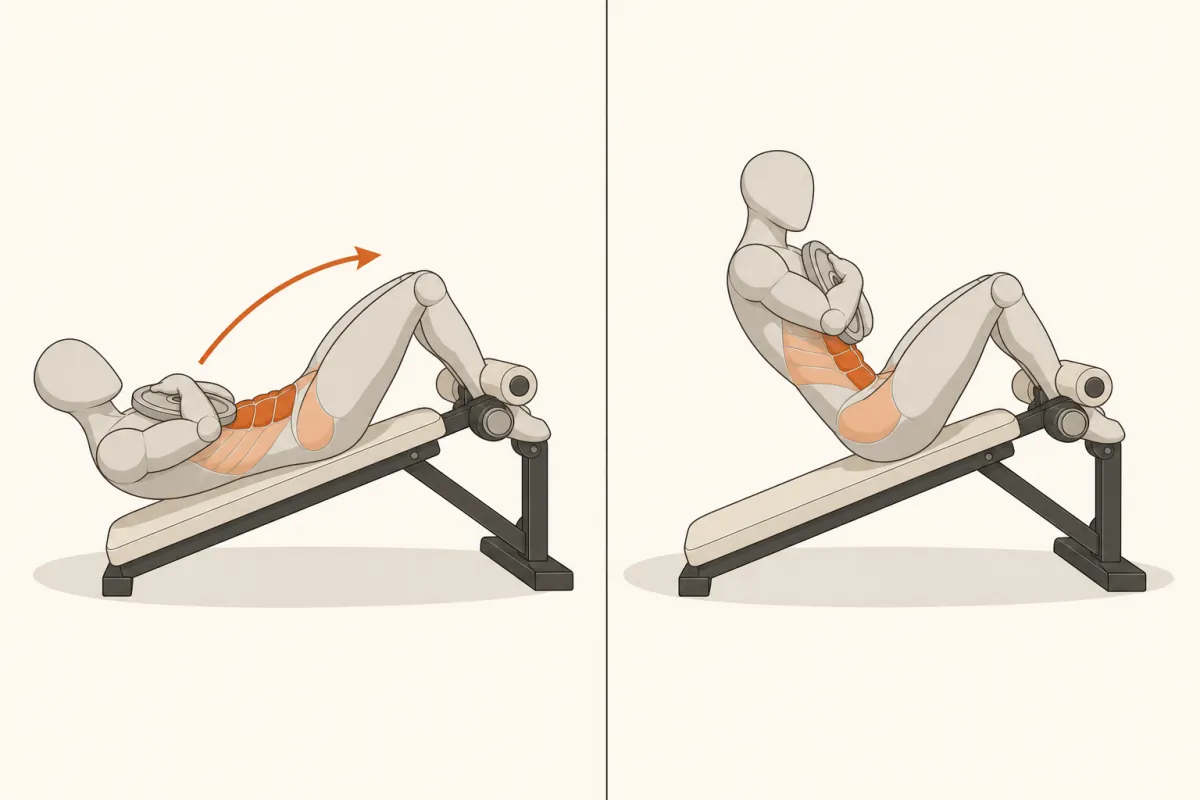
Generated illustration — follow the cues.
Setup
Set a decline ab bench to a moderate angle, hook your feet under the rollers and lie back with the knees bent. Cross your arms on your chest; to load it, hug a weight plate to the chest.
Cues
- Start every rep with a curl: head, shoulders and ribs peel off the bench first.
- Sit up until the trunk is nearly upright, then go straight back down — no resting at the top.
- Exhale on the way up, inhale on the way down.
- Lower over 2–3 s, uncurling the spine back onto the bench.
- Make it harder with a steeper bench or a heavier plate only after 15 clean reps.
Common mistakes
- Yanking up with a flat back by pulling on the foot rollers — the hip flexors take over and compress the lumbar spine.
- Pulling on the head with the hands.
- Dropping back onto the bench.
- Twisting elbow-to-knee while holding a plate: loaded flexion plus twist is the disc-injury mechanism.
- Doing them with an irritable lower back — sit-ups are among the most spine-loading ab exercises; use a crunch or curl-up instead.
Muscles
- Main: Rectus abdominis
- Helping: Hip flexors, Obliques
Alternatives
Machine busy or missing? Closest first.
- Bicycle crunch
- McGill curl-up
- Seated machine crunch
- Kneeling cable crunch
- Reverse crunch
- Captain's chair knee raise
Pick your gym to see which of these it has: Gyms
Warm-up
No ramp sets: make the first set a little easier and build into it.
5 min of easy cardio (bike, rower or brisk incline walk) until you are warm and breathing a little faster, then lighter ramp sets before the first working set of each big exercise.
Facts
- Equipment
- Bodyweight
- Movement
- Crunch
- Swap group
- Crunches
- Load step
- bodyweight
- Rep range
- 8–15 reps
- Difficulty
- Needs some technique
- Support
- You stabilise yourself
- Lower-back load
- High
Also called: Decline bench sit-up · Weighted decline sit-up · Подъём туловища на наклонной скамье
Sources
- Low back loads over a variety of abdominal exercises: searching for the safest abdominal challenge (Axler & McGill) — Med Sci Sports Exerc, 1997. pubmed.ncbi.nlm.nih.gov/9219209/
- Intramuscular activity of psoas and the abdominal wall during a wide variety of tasks (Juker et al.) — Med Sci Sports Exerc, 1998. pubmed.ncbi.nlm.nih.gov/9502361/
- Electromyographic analysis of traditional and nontraditional abdominal exercises (Escamilla et al.) — Physical Therapy, 2006. pubmed.ncbi.nlm.nih.gov/16649890/
- The role of axial torque in disc herniation (Marshall & McGill) — Clin Biomech, 2010. pubmed.ncbi.nlm.nih.gov/19815318/