Neck isometrics (4-way)
- Bodyweight
- Neck
- 10–20 s
- Beginner-friendly
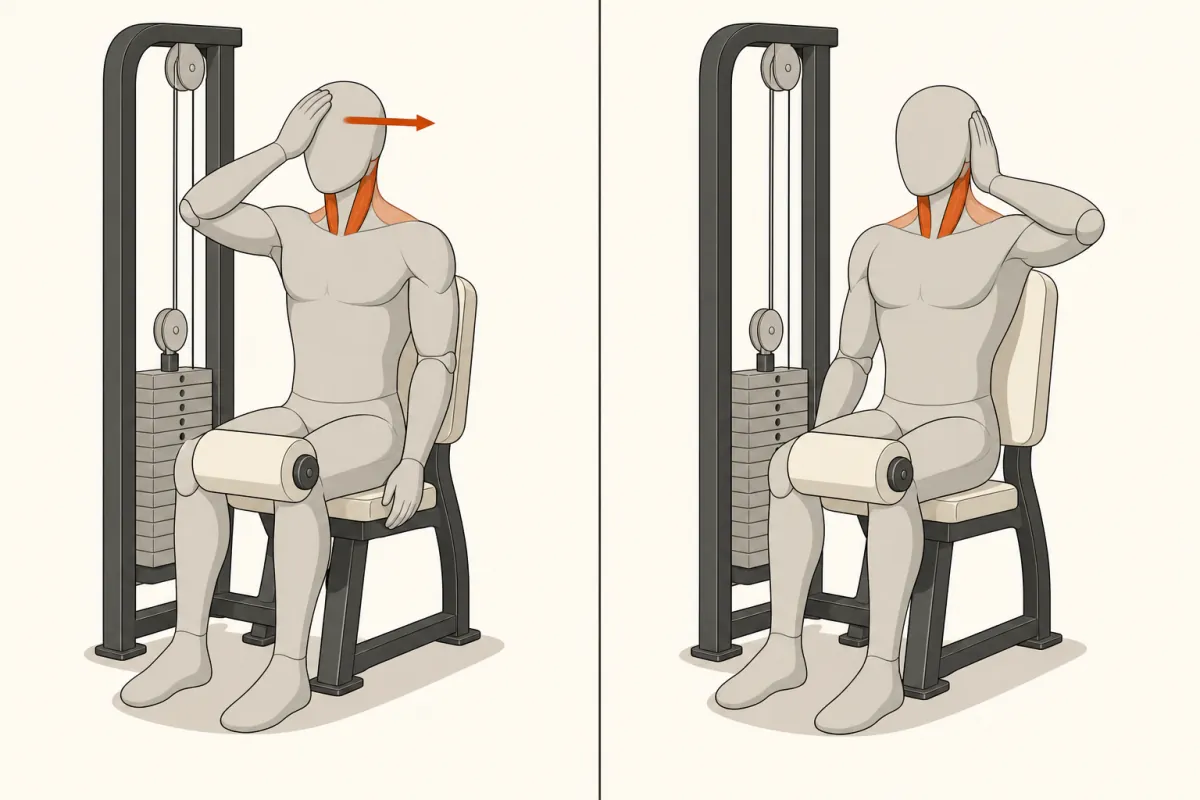
Generated illustration — follow the cues.
Setup
Sit or stand tall with the head in neutral. Press a palm, or both hands, against your forehead, the back of your head or the side of your head and resist with the neck so the head does not move.
Cues
- Build the pressure up over 2–3 s; never start with a jolt.
- Work at moderate effort, about 50–70%, holding 10–20 s per direction.
- Cover all four directions: front, back, left and right.
- Keep breathing during the hold.
- Keep the chin slightly tucked and the head level.
Common mistakes
- Pushing suddenly or at maximal effort.
- Holding the breath.
- Letting the head tilt or turn under the pressure.
- Carrying on through pain, dizziness or tingling.
Muscles
- Main: Neck extensors, Neck flexors
- Helping: Upper traps
Alternatives
Machine busy or missing? Closest first.
Pick your gym to see which of these it has: Gyms
Warm-up
No ramp sets: make the first set a little easier and build into it.
5 min of easy cardio (bike, rower or brisk incline walk) until you are warm and breathing a little faster, then lighter ramp sets before the first working set of each big exercise.
Facts
- Equipment
- Bodyweight
- Movement
- Neck
- Swap group
- Neck
- Load step
- bodyweight
- Rep range
- 10–20 s
- Difficulty
- Beginner-friendly
- Support
- You stabilise yourself
- Lower-back load
- Low
Also called: Manual neck isometrics · Hand-resisted neck holds · 4-way neck isometric holds · Self-resisted neck isometrics
Sources
- Active neck muscle training in the treatment of chronic neck pain in women: a randomized controlled trial — JAMA, 2003. doi.org/10.1001/jama.289.19.2509
- Effects of neck muscle training in women with chronic neck pain: one-year follow-up study — J Strength Cond Res, 2006. doi.org/10.1519/R-17274.1
- Effects of neck strength training on isometric neck strength in rugby union players — Clin J Sport Med, 2014. doi.org/10.1097/JSM.0000000000000071