Dumbbell wrist curl
- Dumbbells
- Wrist curl
- 10–20 reps
- Beginner-friendly
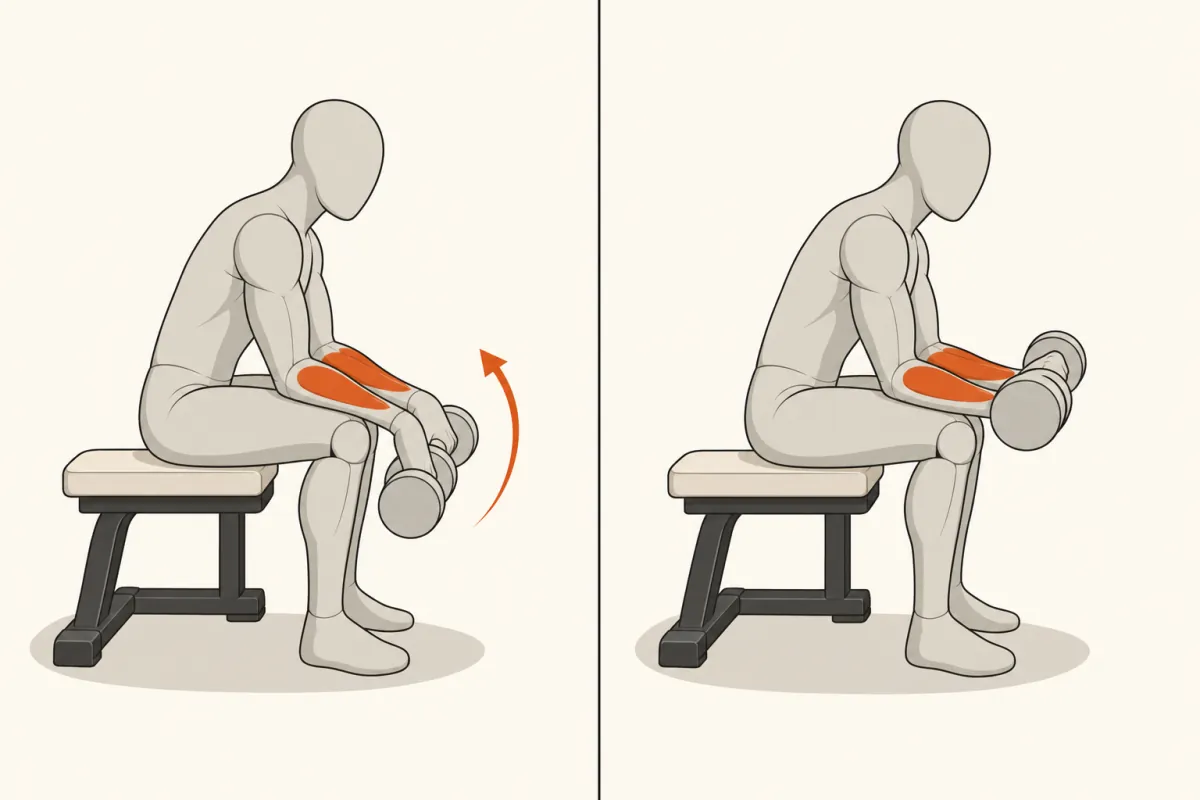
Generated illustration — follow the cues.
Setup
Sit on a bench with your forearms resting on your thighs, palms up, wrists just past your knees, and a dumbbell in each hand.
Cues
- Forearms stay glued to your thighs; only the wrists move.
- Let the wrist bend back under control; you can let the dumbbell roll toward your fingertips.
- Close your fingers and curl the wrist up as high as it goes.
- Move slowly: 1–2 s up, 2 s down, no bouncing.
- Breathe steadily throughout the set.
Common mistakes
- Lifting the forearms off your thighs to swing the weight.
- Heavy, jerky, short reps.
- Letting the dumbbell drop at the bottom, which jolts the wrist.
Muscles
- Main: Forearm flexors (grip)
Alternatives
Machine busy or missing? Closest first.
Pick your gym to see which of these it has: Gyms
Warm-up
No ramp sets at a light working load: the first working set is the warm-up for this muscle.
5 min of easy cardio (bike, rower or brisk incline walk) until you are warm and breathing a little faster, then lighter ramp sets before the first working set of each big exercise.
Facts
- Equipment
- Dumbbells
- Movement
- Wrist curl
- Swap group
- Wrist curls
- Load step
- 1 kg
- Rep range
- 10–20 reps
- Difficulty
- Beginner-friendly
- Support
- You stabilise yourself
- Lower-back load
- Low
- Typical start
- 4 kg (untrained 80 kg man)
Also called: Wrist curl · Seated dumbbell wrist curl · Palms-up wrist curl · Barbell wrist curl
Sources
- Dumbbell Wrist Curl strength standards — Strength Level, 2026. strengthlevel.com/strength-standards/dumbbell-wrist-curl/kg
- Delp, Grierson, Buchanan. Maximum isometric moments generated by the wrist muscles in flexion-extension and radial-ulnar deviation — J Biomech, 1996. doi.org/10.1016/0021-9290(96)00029-2