45° back extension
- Bodyweight
- Back extension
- 8–15 reps
- Needs some technique
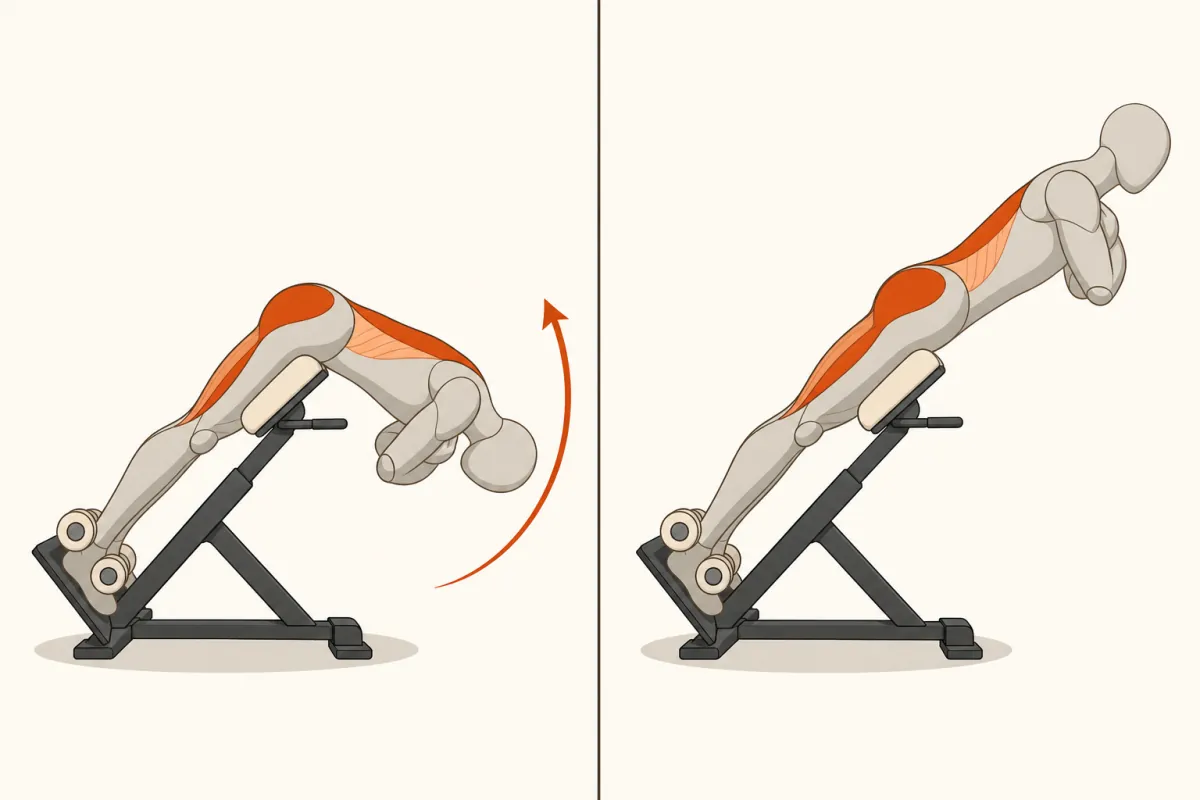
Generated illustration — follow the cues.
Setup
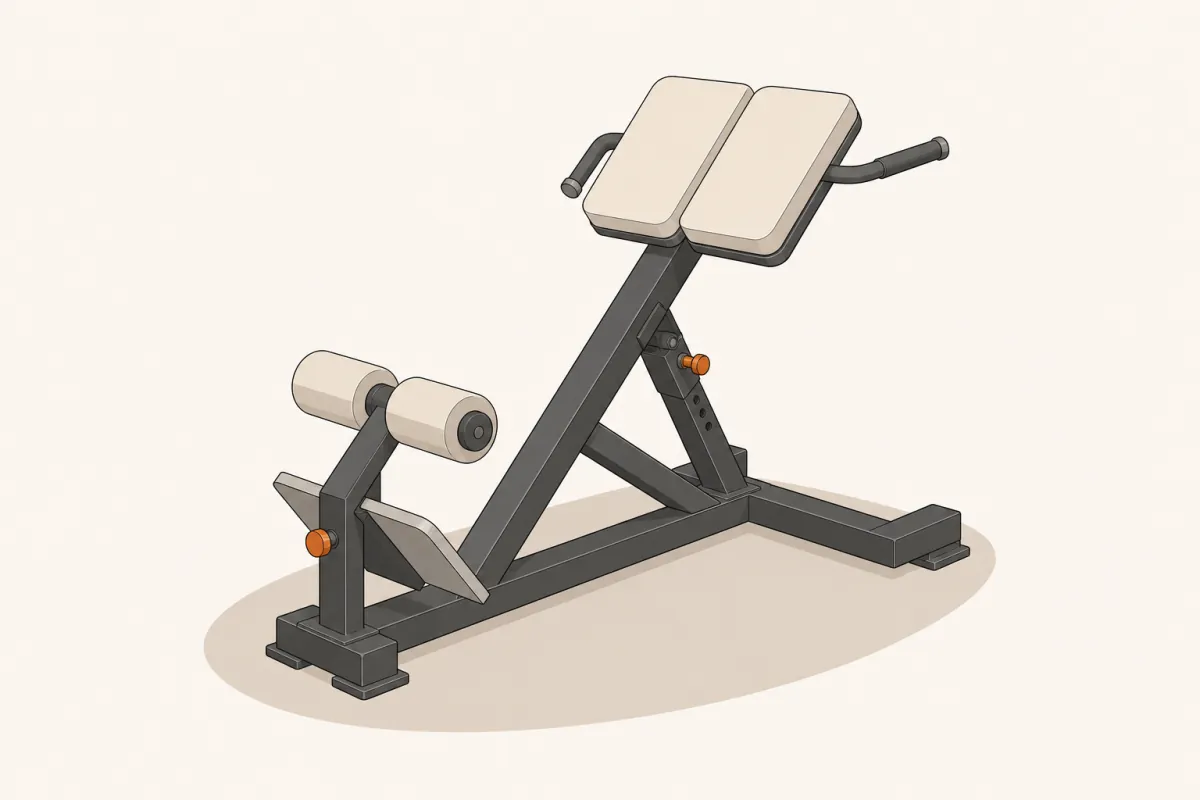
Set the hip pad so its top edge sits just below the crease of your hips (the pelvis must be free to tilt), hook your heels under the ankle rollers and start with the body in a straight line.
Cues
- Cross your arms on your chest; once 15 reps are easy, hold a plate there.
- Hinge at the hips and lower the torso over 2–3 s with a neutral back.
- Go down only as far as you can without the lower back rounding.
- Squeeze the glutes and rise until the body is a straight line, not arched.
- Exhale on the way up and keep the chin slightly tucked.
- Turn the toes slightly in to bias the lower-back muscles (about 18% more activity than with the toes turned out).
Common mistakes
- Hyperextending at the top, arching past a straight line.
- Pad set too high, so the hips cannot bend and the lower back bends instead.
- Bouncing out of the bottom or swinging up with momentum.
- Rounding the lower back under load at the bottom.
- Holding a plate behind the head, which strains the neck.
Muscles
- Main: Spinal erectors, Gluteus maximus, Hamstrings
- Helping: Quadratus lumborum
Alternatives
Machine busy or missing? Closest first.
Pick your gym to see which of these it has: Gyms
Warm-up
No ramp sets: make the first set a little easier and build into it.
5 min of easy cardio (bike, rower or brisk incline walk) until you are warm and breathing a little faster, then lighter ramp sets before the first working set of each big exercise.
Facts
- Equipment
- Bodyweight
- Movement
- Back extension
- Swap group
- Back extensions
- Load step
- bodyweight
- Rep range
- 8–15 reps
- Difficulty
- Needs some technique
- Support
- You stabilise yourself
- Lower-back load
- Moderate
Also called: 45-degree hyperextension · Roman chair back extension · 45° Back Hyperextension (Technogym Pure Strength) · Hyperextension bench · Back raise
Sources
- Electromyographic activity of the trunk extensor muscles: effect of varying hip position and lumbar posture during Roman chair exercise — Arch Phys Med Rehabil, 2002. doi.org/10.1053/apmr.2002.35103
- Back extension endurance and strength: the effect of variable-angle Roman chair exercise training — Spine, 2002. doi.org/10.1097/00007632-200208150-00016
- Effect of Roman chair exercise training on the development of lumbar extension strength — J Strength Cond Res, 2003. pubmed.ncbi.nlm.nih.gov/12741878/
- Back Extension Standards — Strength Level, 2026. strengthlevel.com/strength-standards/back-extension