Bird dog
- Bodyweight
- Anti-rotation
- 5–10 reps
- Beginner-friendly
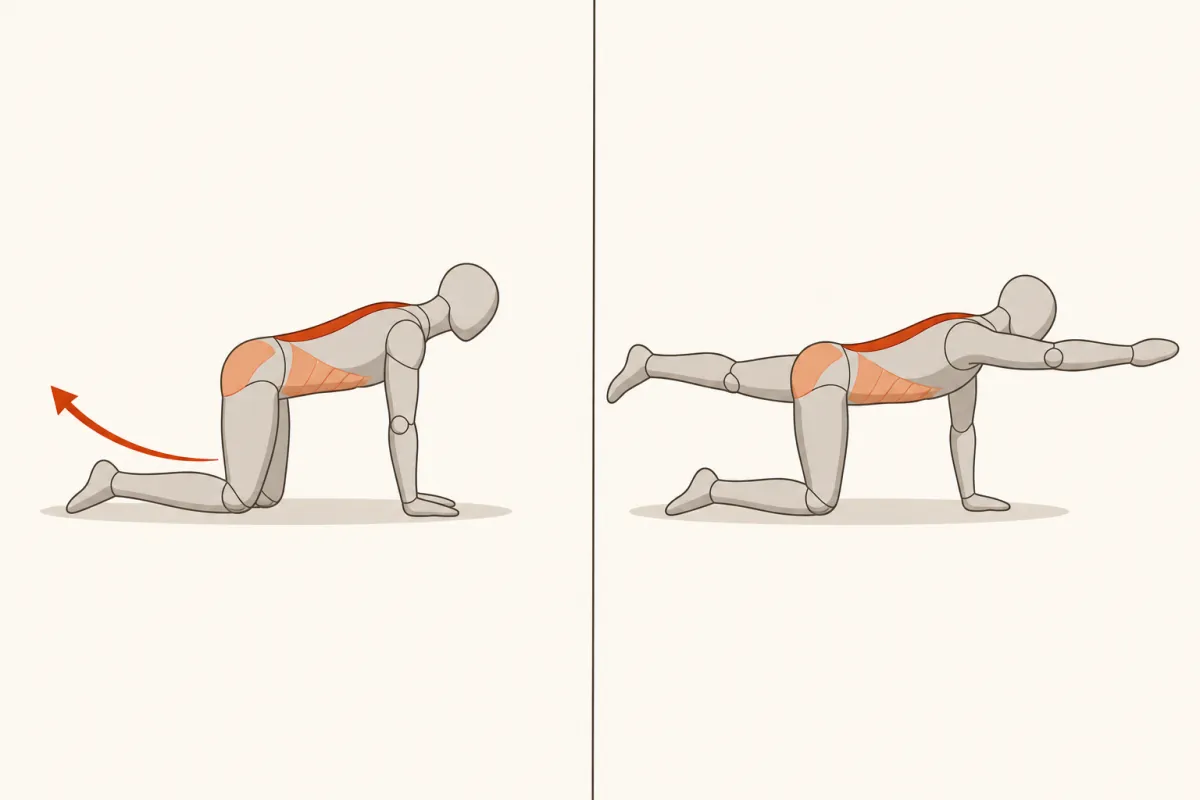
Generated illustration — follow the cues.
Setup
Start on hands and knees: hands under the shoulders, knees under the hips, spine neutral. Brace the abs lightly, as if someone were about to poke your belly.
Cues
- Slowly reach one arm forward and the opposite leg back until both are level with your back — no higher.
- Push the heel back and reach long with the fingertips: the body gets longer, not higher.
- Keep hips and shoulders square and still, as if a glass of water stood on your lower back.
- Hold 5–10 s at full reach and keep breathing.
- Bring the hand and knee back under you without sagging, then switch sides; reps are counted per side.
- Progress: draw small squares with the hand and foot while the spine stays completely still.
Common mistakes
- Lifting the leg above hip height and arching the lower back.
- Rotating or hiking the hip on the side of the raised leg.
- Swinging through fast reps instead of holding the position.
- Holding the breath during the hold.
Muscles
- Main: Spinal erectors
- Helping: Gluteus maximus, Obliques, Transverse abdominis
Alternatives
Machine busy or missing? Closest first.
Pick your gym to see which of these it has: Gyms
Warm-up
No ramp sets: make the first set a little easier and build into it.
5 min of easy cardio (bike, rower or brisk incline walk) until you are warm and breathing a little faster, then lighter ramp sets before the first working set of each big exercise.
Facts
- Equipment
- Bodyweight
- Movement
- Anti-rotation
- Swap group
- Spine stability
- Load step
- bodyweight
- Rep range
- 5–10 reps
- Difficulty
- Beginner-friendly
- Support
- You stabilise yourself
- Lower-back load
- Low
- Sides
- One side at a time
Also called: Birddog (McGill 'big 3') · Quadruped opposite arm and leg raise · Подъём руки и ноги на четвереньках
Sources
- Exercises for spine stabilization: motion/motor patterns, stability progressions and clinical technique (McGill & Karpowicz) — Arch Phys Med Rehabil, 2009. pubmed.ncbi.nlm.nih.gov/19154838/
- To crunch or not to crunch: spinal flexion exercises, their potential risks and program design (Contreras & Schoenfeld) — Strength Cond J, 2011. doi.org/10.1519/SSC.0b013e3182259d05