Dead bug
- Bodyweight
- Anti-extension
- 6–12 reps
- Beginner-friendly
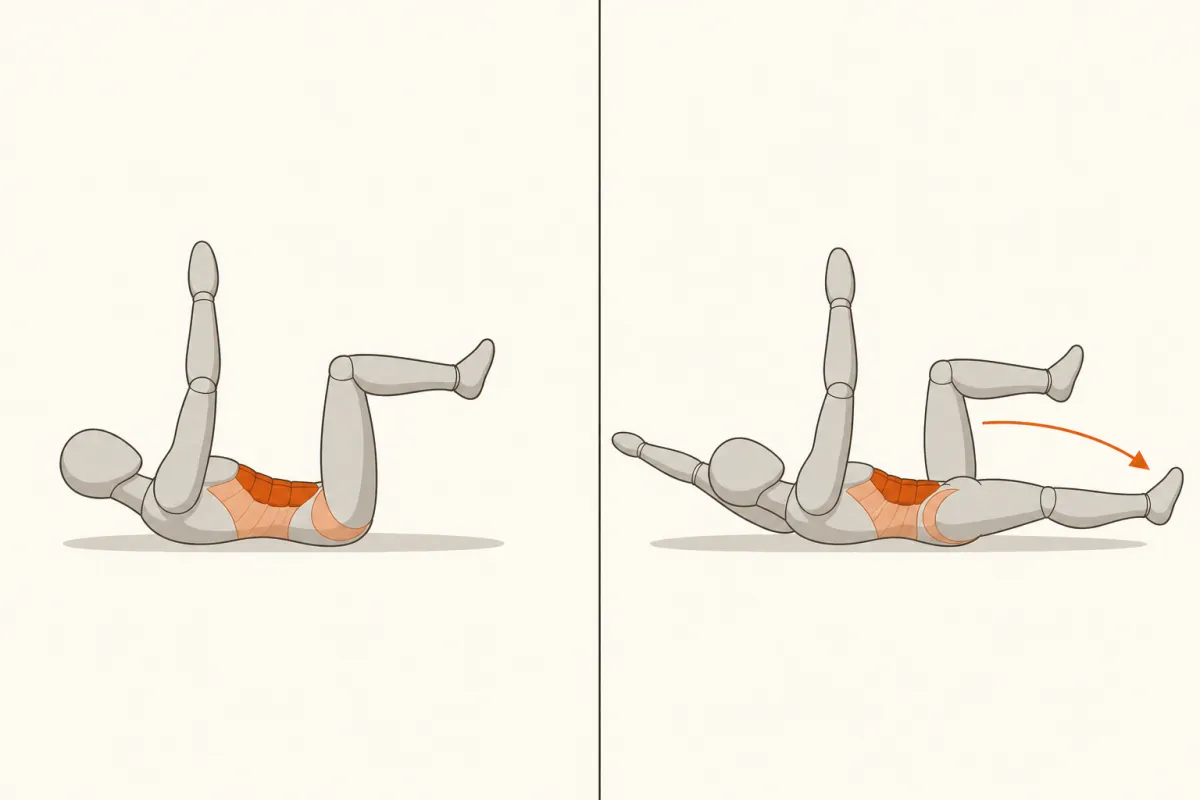
Generated illustration — follow the cues.
Setup
Lie on your back with hips and knees bent to 90° and arms pointing at the ceiling. At first, slide one hand under your lower back to feel that it does not move, and work the other arm with the opposite leg.
Cues
- Brace first: ribs down toward the pelvis, lower back still.
- Exhale and lower one arm overhead and the opposite leg toward the floor over 3 s.
- Stop just above the floor, or earlier if your lower back starts to lift off your hand.
- Pause, bring both limbs back and switch sides; reps are counted per side.
- Keep the head and shoulders relaxed on the floor.
- Progress: straighter legs, then a light dumbbell in the hands.
Common mistakes
- Lower back arching off the floor as the leg goes down — the range is too big.
- Rushing and swinging the arms and legs.
- Holding the breath instead of exhaling as the limbs extend.
- Lifting the head and straining the neck.
Muscles
- Main: Rectus abdominis, Transverse abdominis
- Helping: Obliques, Hip flexors
Alternatives
Machine busy or missing? Closest first.
Pick your gym to see which of these it has: Gyms
Warm-up
No ramp sets: make the first set a little easier and build into it.
5 min of easy cardio (bike, rower or brisk incline walk) until you are warm and breathing a little faster, then lighter ramp sets before the first working set of each big exercise.
Facts
- Equipment
- Bodyweight
- Movement
- Anti-extension
- Swap group
- Spine stability
- Load step
- bodyweight
- Rep range
- 6–12 reps
- Difficulty
- Beginner-friendly
- Support
- Seat or pad supports the torso
- Lower-back load
- Low
- Sides
- One side at a time
Also called: Dying bug · Supine opposite arm and leg lowering · Опускание руки и ноги лёжа на спине
Sources
- Exercises for spine stabilization: motion/motor patterns, stability progressions and clinical technique (McGill & Karpowicz) — Arch Phys Med Rehabil, 2009. pubmed.ncbi.nlm.nih.gov/19154838/
- Exercise technique: the dead bug (Mullane, Turner & Bishop) — Strength Cond J, 2019. doi.org/10.1519/SSC.0000000000000455