Side plank
- Bodyweight
- Side stability
- 20–45 s
- Beginner-friendly
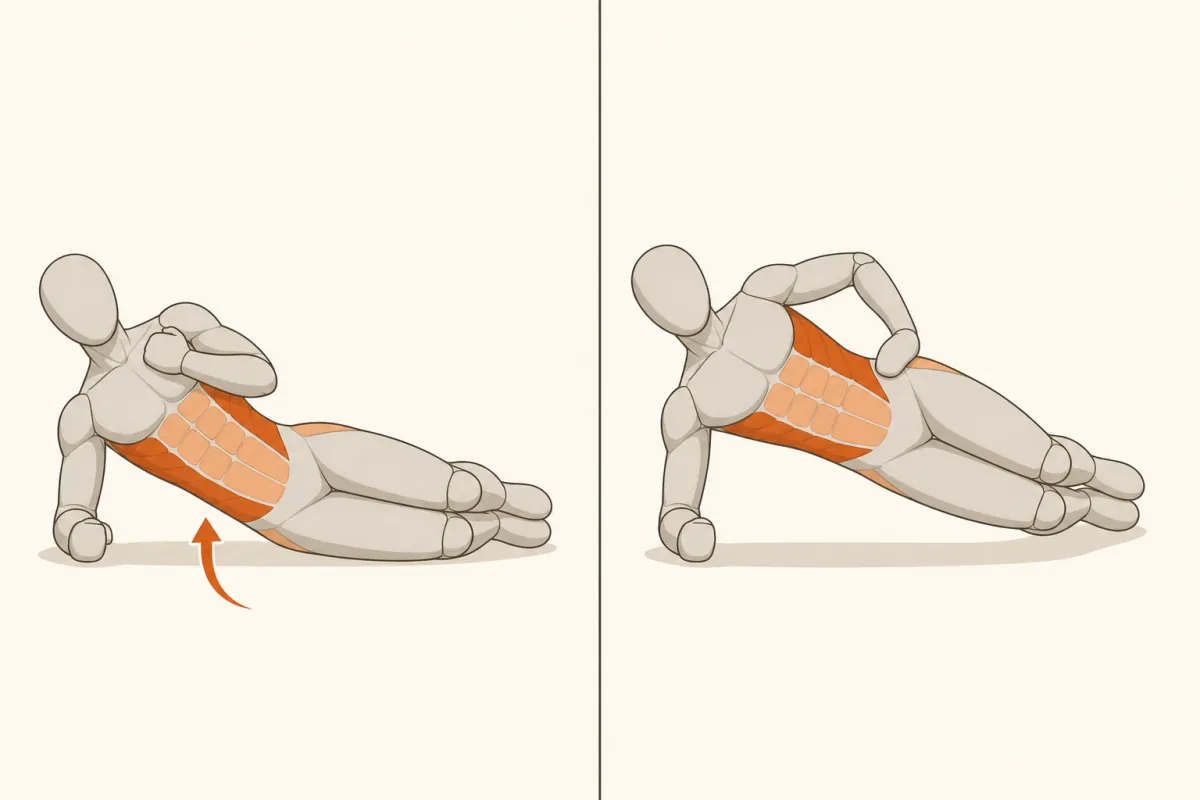
Generated illustration — follow the cues.
Setup
Lie on your side with the elbow directly under the shoulder, legs straight, top foot in front of the bottom one. Beginners start from the knees, knees bent to 90°.
Cues
- Lift the hips until the body is a straight line from head to feet.
- Lock the ribcage to the pelvis: don't roll the chest forward or the hips back.
- Push the floor away with the elbow so the shoulder doesn't sink toward the ear.
- Rest the top hand on the opposite shoulder, later on the hip.
- Breathe steadily through the whole hold; give both sides the same time.
- Progress: knees → feet → a slow roll through a plank to the other side.
Common mistakes
- Hips sagging toward the floor.
- Twisting: the chest rolls toward the floor or the hips drift back.
- Elbow placed away from the shoulder, so the shoulder joint takes the load.
- Holding the breath.
Muscles
- Main: Obliques, Quadratus lumborum
- Helping: Transverse abdominis, Gluteus medius, Rectus abdominis
Alternatives
Machine busy or missing? Closest first.
Pick your gym to see which of these it has: Gyms
Warm-up
No ramp sets: make the first set a little easier and build into it.
5 min of easy cardio (bike, rower or brisk incline walk) until you are warm and breathing a little faster, then lighter ramp sets before the first working set of each big exercise.
Facts
- Equipment
- Bodyweight
- Movement
- Side stability
- Swap group
- Spine stability
- Load step
- bodyweight
- Rep range
- 20–45 s
- Difficulty
- Beginner-friendly
- Support
- You stabilise yourself
- Lower-back load
- Low
- Sides
- One side at a time
Also called: Side bridge (McGill 'big 3') · Side support · Боковой мост
Sources
- Exercises for spine stabilization: motion/motor patterns, stability progressions and clinical technique (McGill & Karpowicz) — Arch Phys Med Rehabil, 2009. pubmed.ncbi.nlm.nih.gov/19154838/
- Intramuscular activity of psoas and the abdominal wall during a wide variety of tasks (Juker et al.) — Med Sci Sports Exerc, 1998. pubmed.ncbi.nlm.nih.gov/9502361/
- Endurance times for low back stabilization exercises: a normal database (McGill, Childs & Liebenson) — Arch Phys Med Rehabil, 1999. pubmed.ncbi.nlm.nih.gov/10453772/